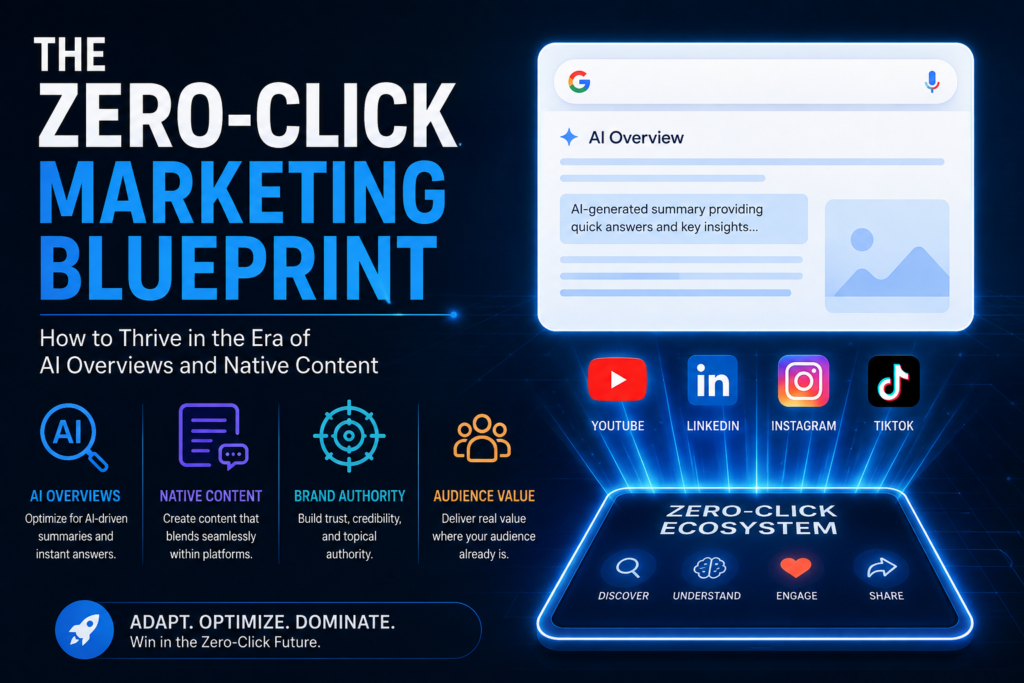
The Zero-Click Marketing Blueprint: How to Thrive in the Era of AI Overviews and Native Content
Step into the shoes of the average internet user for a moment. You want to know the current inflation rate, the best time to visit Tokyo, or a quick script to fix a Python error. You type your query into a search engine. Ten years ago, you would automatically click the first or second blue link, navigate to a blog, decline a cookie banner, close an email pop-up, and scroll through 800 words of introductory filler to find your answer.
Today, you don’t do any of that.
The search engine answers your question immediately at the top of the screen using an AI-generated summary, a featured snippet, or an interactive widget. You read the answer in five seconds, close the tab, and move on with your day. You got exactly what you needed, but the website that actually created that information received zero traffic, zero ad impressions, and zero email signups. This is the reality of the zero-click internet, and it is the environment where zero-click marketing is becoming increasingly important.
For digital marketers, business owners, and content creators, this shift can feel catastrophic. Traditional Search Engine Optimization (SEO) and social media marketing were built on a simple economic transaction: we provide free, high-quality content, and the platforms provide us with outbound web traffic. With zero-click marketing, however, the goal is no longer simply to make users click a link. Instead, brands must focus on building visibility, authority, recognition, and engagement directly within search results and native platforms.
This transaction is officially changing. Platforms like Google, LinkedIn, Meta, and X are working overtime to keep users inside their walled gardens. As a result, zero-click marketing gives businesses a new way to reach audiences even when those audiences never visit their websites.
But a drop in website traffic does not necessarily mean a drop in marketing effectiveness. To survive in this new environment, you must abandon the legacy “click-first” mentality and master zero-click marketing and content optimization. The future belongs to brands that can provide valuable answers, establish authority, and remain visible wherever their audiences are searching, scrolling, and consuming content—even when no click happens.
1. The Mechanics of the Zero-Click Landscape
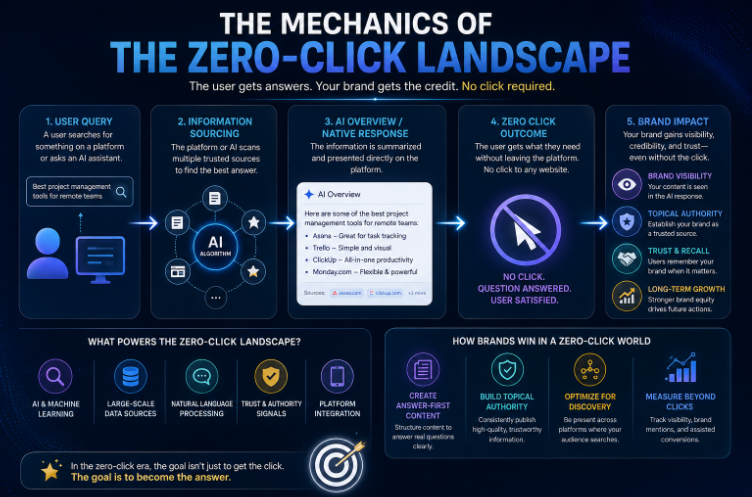
To defeat a challenge, you must first understand how it operates. A zero-click search occurs when a user’s query is completely answered on the Search Engine Results Page (SERP) itself, requiring no further navigation to an external hyperlink. This change is one of the main reasons why zero-click marketing has become an important strategy for modern digital marketers.
AI Overviews (Generative Summaries)
Powered by large language models, AI search features can synthesize information from multiple web sources into a cohesive, conversational answer at the top of the SERP. They eliminate the user’s need to cross-reference multiple sites because the machine has already done much of the reading, filtering, and summarizing for them. For zero-click marketing, this means brands need to optimize their content not only for clicks but also for visibility, authority, and inclusion within AI-generated search experiences.
Rich Featured Snippets and Knowledge Panels
Whether it is an FAQ drop-down, a recipe card, a weather widget, or a bulleted step-by-step list extracted from an article, these rich search elements continue to capture significant real estate on the SERP. They often target high-volume, low-complexity informational queries and contribute directly to the growth of zero-click marketing. Instead of measuring success only through website visits, marketers need to consider how effectively their content provides immediate value within search results.
Social Media Walled Gardens
This shift isn’t exclusive to search engines. Social media networks increasingly encourage users to consume content without leaving the platform. If you paste an outbound link into a LinkedIn post, an X post, or a Facebook update, the platform may prioritize native content because it wants to maximize user engagement and dwell time.
This is where zero-click marketing becomes especially valuable. Rather than constantly pushing users toward an external website, marketers can deliver useful information directly through social posts, videos, carousels, comments, and other native formats. The objective is to build awareness, trust, and authority before asking users to take the next step.
The numbers back up the broader shift toward zero-click experiences. Across global search behaviors, many queries can now be resolved without a single outbound click. If your entire digital marketing strategy relies on pulling people away from their preferred platforms and onto your site, you may be fighting against the modern user experience.
A successful zero-click marketing strategy adapts to this reality. Instead of treating every impression without a click as a failure, marketers can use search visibility, native content, brand recognition, and audience engagement as valuable marketing outcomes.
2. The Mental Pivot: Impressions as the New Click
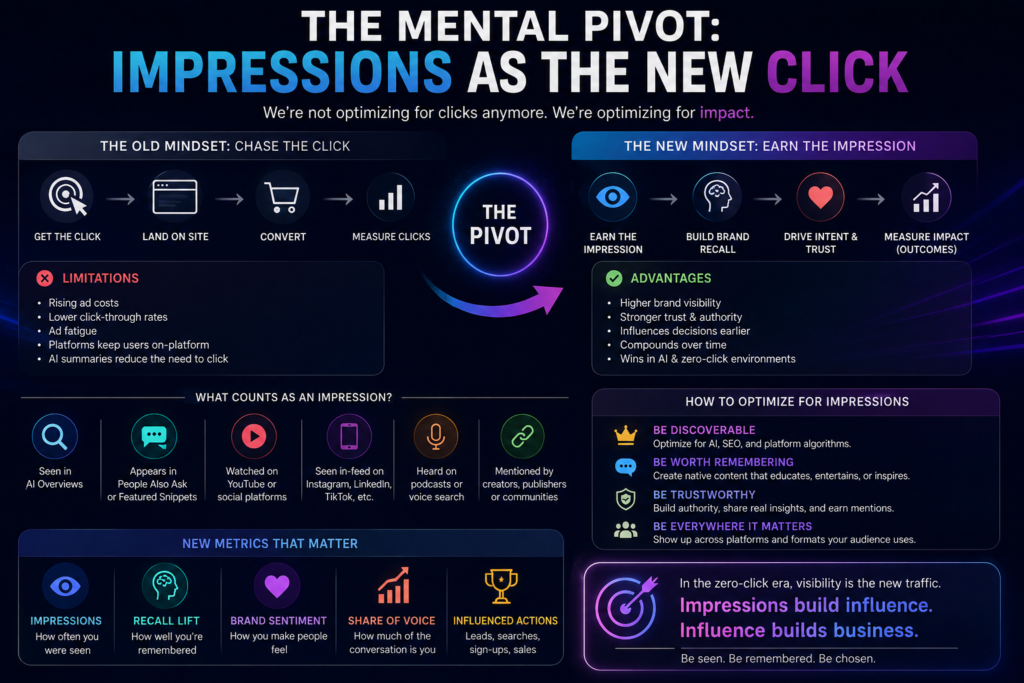
The foundational error most marketers make when adapting to zero-click marketing is treating an impression as a vanity metric. In a traditional marketing funnel, a million impressions meant little if your click-through rate (CTR) was zero. In a zero-click marketing ecosystem, however, the impression itself becomes the content delivery vehicle.
Instead of trying to hoard your knowledge behind a website wall, zero-click marketing requires you to distribute your core value directly on the feed or the Search Engine Results Page (SERP). This means shifting from a traditional traffic-generation model to a brand-equity model, where visibility, authority, and recognition become important measures of marketing success.
Think about it from a psychological perspective. If a user searches for a complex marketing problem and Google’s AI Overview answers it using a citation from your brand, or if a user reads a comprehensive text carousel on LinkedIn detailing your exact marketing framework, they may not click through to your site today. However, your zero-click marketing strategy has just helped your brand solve a real-world problem for them completely for free, right where they were.
You haven’t lost a lead; you have built undeniable, friction-free authority. When that user eventually needs to hire a professional agency, buy a premium software tool, or enroll in an advanced course, your brand is already top-of-mind. Zero-click marketing trades short-term referral clicks for long-term brand equity, stronger brand recognition, and increased direct-navigation search volume.
The goal of zero-click marketing is therefore not to eliminate clicks completely. It is to make every impression valuable—even when the user doesn’t click.
3. Structural Optimization: Writing Content for Machines and Skimmers
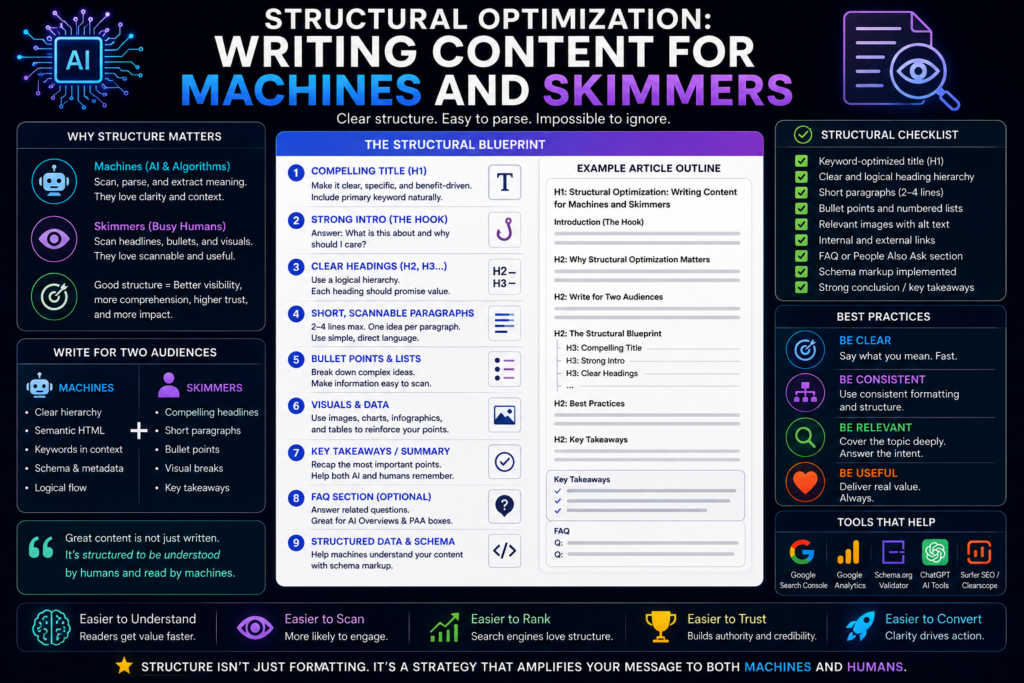
To win zero-click marketing real estate, your content creation process must undergo an architectural rewrite. You can no longer rely on meandering, slow-burn essays designed primarily to maximize page-scroll depth. Instead, zero-click marketing requires optimized, bite-sized information blocks that machines can easily parse and humans can instantly understand.
The Direct-Answer Architecture
When structuring a blog post or article for zero-click marketing, treat every subheader (H2 or H3) as a standalone user query. Immediately beneath that subheader, provide an explicit, bolded 40-to-60-word summary that answers the question directly without unnecessary fluff.
Bad Architecture: Writing a long historical narrative about an industry trend before slowly revealing your solution in the middle of a paragraph on page three.
Good Architecture: Placing a clear, declarative definition block directly beneath the heading, followed by an analytical breakdown, bulleted structural lists, or data tables.
Why does this work? AI search systems and web crawlers look for structural clarity and easily extractable information. When a search engine parses a page and finds an explicit, data-rich statement positioned beneath a relevant header, that content has a stronger opportunity to be surfaced in AI-generated answers, featured snippets, and other zero-click search experiences.
Technical Schema Payload Optimization
Human readability must be reinforced with mechanical accessibility. A successful ze
4. Native Platform Delivery: Giving Away the Secrets
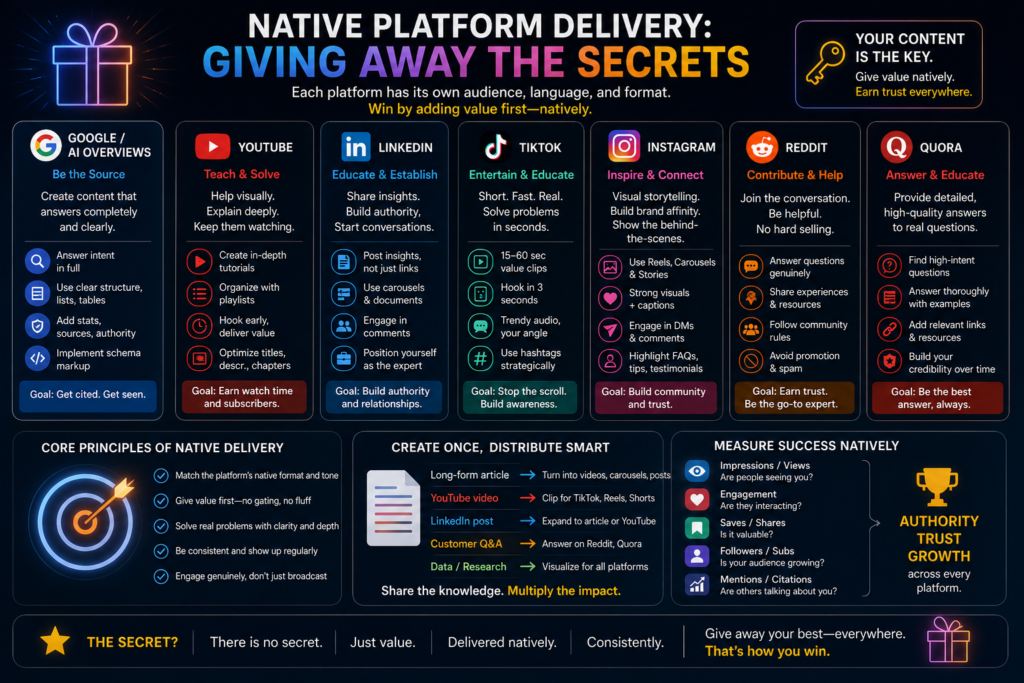
If you are publishing content on social channels, you must design formats that fully satisfy programmatic consumption criteria natively. Zero-click marketing means moving beyond the idea of social media as a billboard for promoting your blog. Instead, treat social media as the blog itself and deliver the complete value directly within the platform.
Value-Packed Text Carousels (LinkedIn & Instagram)
Instead of posting a teaser sentence and a link to an external case study, build the entire case study into a 7-slide visual or textual carousel. This approach supports zero-click marketing by allowing users to consume valuable information without leaving the platform.
Frame 1: Introduce the shocking problem.
Frames 2–5: Present the exact data, charts, and steps taken to solve it.
Frame 6: Reveal the quantitative results.
Frame 7: Deliver a direct call-to-action, such as following your profile or subscribing through a linkless text mention.
The goal of zero-click marketing is to make the content valuable enough that users do not need to visit another website to understand the main idea.
Long-Form In-Feed Essays
Convert your standard 1,200-word blog posts into highly direct, scannable text posts published directly within the platform’s description fields. Use clear formatting, short sentences, bulle
5. Rewriting the Marketing Funnel and Attribution Models
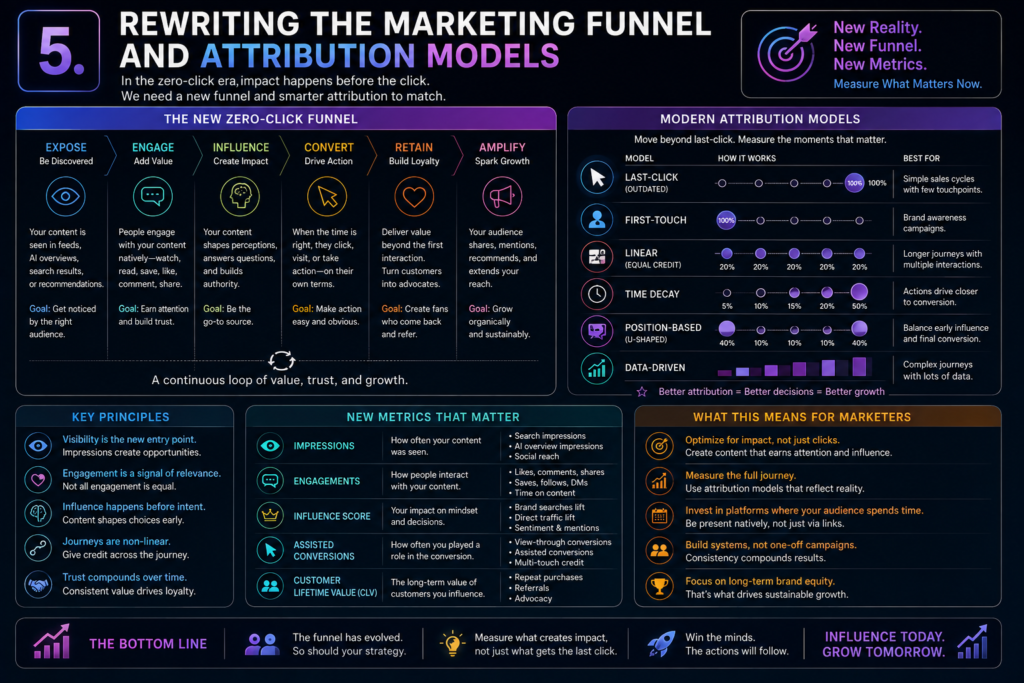
If users are consuming your content on external platforms and search engines without visiting your website, traditional marketing analytics, such as Google Analytics 4 tracking data, may show a massive drop-off. If you continue measuring success using old traffic metrics, your marketing data can look broken even when your business revenue is growing. This is why zero-click marketing requires a new approach to measurement and attribution.
You must upgrade your attribution frameworks to match the zero-click marketing reality.
Track Branded Search Volume Spikes
When your zero-click marketing and content optimization strategy is succeeding, users may see your brand name cited repeatedly in AI Overviews and native social feeds. They may not click the link immediately, but later they can open a browser and search for your exact brand name, product, or proprietary framework.
A steady upward trend in direct website navigation and branded organic keywords can therefore become an important indicator of successful zero-click marketing saturation. Instead of focusing exclusively on clicks, marketers should monitor how often their content creates brand recognition and drives future search behavior.
Deploy Qualitative Attribution Identifiers
Software trackers can easily misattribute a direct visit as an anonymous user who randomly landed on your homepage. To expose these blind spots, insert a mandatory, open-ended qualitative question within your landing-page lead forms and contact pipelines:
“Where did you first experience our insights?”
When leads provide answers such as “I saw your framework summarized in a Google AI Overview last week” or “I read your full case study teardown natively on LinkedIn,” you gain valuable, human-verified evidence of which zero-click marketing ecosystems are influencing your actual bottom-line revenue.
Build a First-Party Flywheel
Use zero-click marketing channels to drive high-intent actions rather than casual page views. When you do provide an external link,